

Mastering the challenges
Risk management
The challenges lie in the unprecedented scale and the speed at which the risks are developing. There is no history for this; there have been no comparable events so far.
Modelling is the basis for managing both the risks and the opportunities of the transition.
For this reason the modelling of the transition is decisive, with the choice of the estimator of the transition being the key aspect. This makes the choice of model and the model implementation the central aspect for the success of the forecasts and for the risk. For this reason we apply the gold standard in model risk management, the regulatory requirements from the financial sector.
The special feature of the transition lies in the new, developing risks. The task is to build up risk management for something unknown. The BIS pointed this out as early as January 20201. It calls for epistemologically new approaches, both for the management of transition risks and for financial risk management. In the former, the models used so far have proved to be fundamentally inadequate, and financial risk management models are traditionally backward looking. They cannot recognise the developing risks.
1 Bank for International Settlement: The green swan, Jan. 2020, https://www.bis.org/publ/othp31.htm

Underestimated disruption
Risk management at the limit
Successful technology transitions show that disruption is fundamentally underestimated2, and therein lies the greatest risk. Yet the transition risks would be easy to manage if the best estimator for technology transitions, the empirical evidence of past transitions, were used consistently.
One of the reasons for the underestimation of technology transitions lies in their exponential development and in our preference for assessing developments as linear. Another lies in the interplay of no fewer than four technology transitions developing in parallel and exponentially: renewables, battery technology, e-mobility and heat generation.
Developing risks can hardly be met with the established risk management approaches. The methods have to be rethought and redesigned. The generic risk management cycle can still be transferred, but as early as risk identification and risk analysis the previous approach no longer holds.
2 Kodak, Nokia, RIM – Blackberry, etc. etc.
Risk identification
The scale of the risks is essentially unknown; it is developing, it is building up. Speed and extent are unknown. In order to assess the risk, knowledge of the probable course of the transition is indispensable. Without modelling this cannot be achieved.
This gives the choice of model decisive importance; the wrong model quickly leads to wrong decisions, to decisions that can be expensive or even threaten a company's existence. The choice of model alone is not enough, the model has to be used adequately. Rarely have models been so decisive, since they provide the basis for extremely far-reaching decisions. The model risks that come with the choice and use of a model have to be managed.
There are indeed models for the transition, and many expert estimates as well, but almost all of them proved to be untenable after a short time. The transition is generally advancing faster than generally forecast. Integrated assessment models and expert estimates are among the best-known models. However, these models do not achieve satisfactory reliability3, and neither do expert estimates. Experts are very good in their specialist fields, but they can hardly estimate future developments.
As already mentioned under modelling, the empirical evidence of past successful technology transitions has proved to be an outstanding estimator. Empirically based models can be an outstanding basis for risk identification, provided they are adequately designed and applied. Assessing and monitoring the quality of the models is a challenge; model risk management takes on paramount importance.
Our modelling shows the probable development. Wright's Law, empirically confirmed and used in the modelling, demonstrates the economic advantages of the transition. Worldwide, the costs of the transition will with high probability be considerably lower than the costs of continuing to use fossil fuels. It is precisely this that will drive the transition further, since renewables from new large-scale plants are already the cheapest source of energy today. The harbingers of the transition can also be seen elsewhere; the considerable divestments in fossil fuels are just one indicator among many.

3 Model reliability: expert models: Jing Meng, Rupert Way, Elena Verdolini, and Laura Diaz Anadon. Comparing expert elicitation and model-based probabilistic technology cost forecasts for the energy transition. Proceedings of the National Academy of Sciences, 118(27), 2021. ISSN 0027- 8424. doi: 10.1073/pnas.1917165118. https://www.inet.ox.ac.uk/publications/comparing-expert-elicitation-and-model-based-probabilistic-technology-cost-forecasts-for-the-energy-transition
IAMs: Marc Jaxa-Rozen and Evelina Trutnevyte. Sources of uncertainty in long-term global scenarios of solar photovoltaic technology. Nature Climate Change, 11(3):266–273, Mar 2021. ISSN 1758-6798. doi: 10.1038/s41558-021-00998-8. URL https://doi.org/10. 1038/s41558-021-00998-8.
&
C. Wilson, A. Grubler, N. Bauer, V. Krey, and K. Riahi. Future capacity growth of energy technologies: are scenarios consistent with historical evidence? Climatic Change, 118(2): 381–395, May 2013. ISSN 1573-1480. doi: 10.1007/s10584-012-0618-y. URL https: //doi.org/10.1007/s10584-012-0618-y.
The risk management aspects in detail
Risk identification
One of the greatest risks is model risk
The remarks above show the outstanding importance of model risk. The use of an inadequate model entails risks that do not only endanger companies because they fail to prepare for the change in good time. Inadequate models will with high probability endanger entire economies. Remarkably, some oil-producing states have already recognised the rapid energy transition.
For the management of model risks there are proven banking-regulatory standards; the leading one is SR 11-7: Guidance on Model Risk Management. Implementing these standards requires extensive experience and should not be taken lightly. Even building up a corresponding modelling history of several years is not without its challenges. Extensive research has to be carried out into the time series required and into the quality of the available estimators. A sufficient history of the modelling has to be built up in order to validate it. In credit risk models a history of 5 years is required. We consider this necessary for climate models as well. In validation, the deviations from the modelled trend, the volatility around the trend, also have to be explained, for example Corona. It becomes more challenging when the interplay of the four technology transitions has to be taken into account.
In parallel with the pure modelling, other aspects have to be analysed: where can bottlenecks occur, how can they be overcome? Where are the political risks? How strong can the resistance of the fossil sector be? After that, a corresponding history has to be built up. This raises the question of whether there is still enough time for that or whether the possible fire sale of fossil assets could set in earlier.
Further risk identification requires good modelling of the transition of the individual technologies, such as batteries, the replacement of fossil power generation, etc. Without an expectation of the development, of the growth of renewables, of battery production, of e-mobility and of heat production, the risk cannot be assessed. Good models are indispensable, despite the model risk associated with them.
Scenarios
Scenarios are a proven means in the risk analysis of developing risks. Model-based, they are neutral and free of bias. The following charts show the expected course of the transition (left) and the course if the growth rates of renewables fall immediately by 1/3.
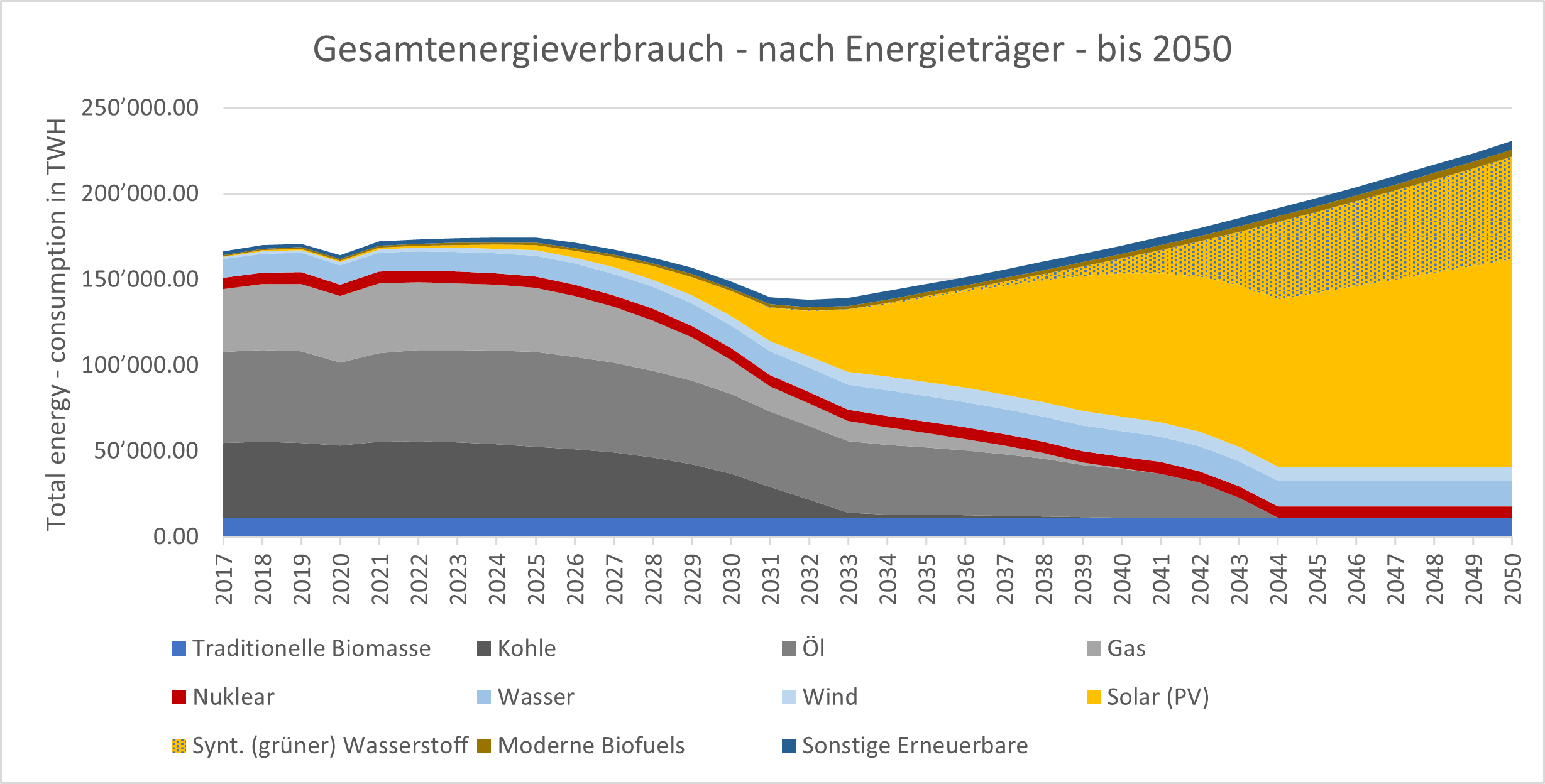
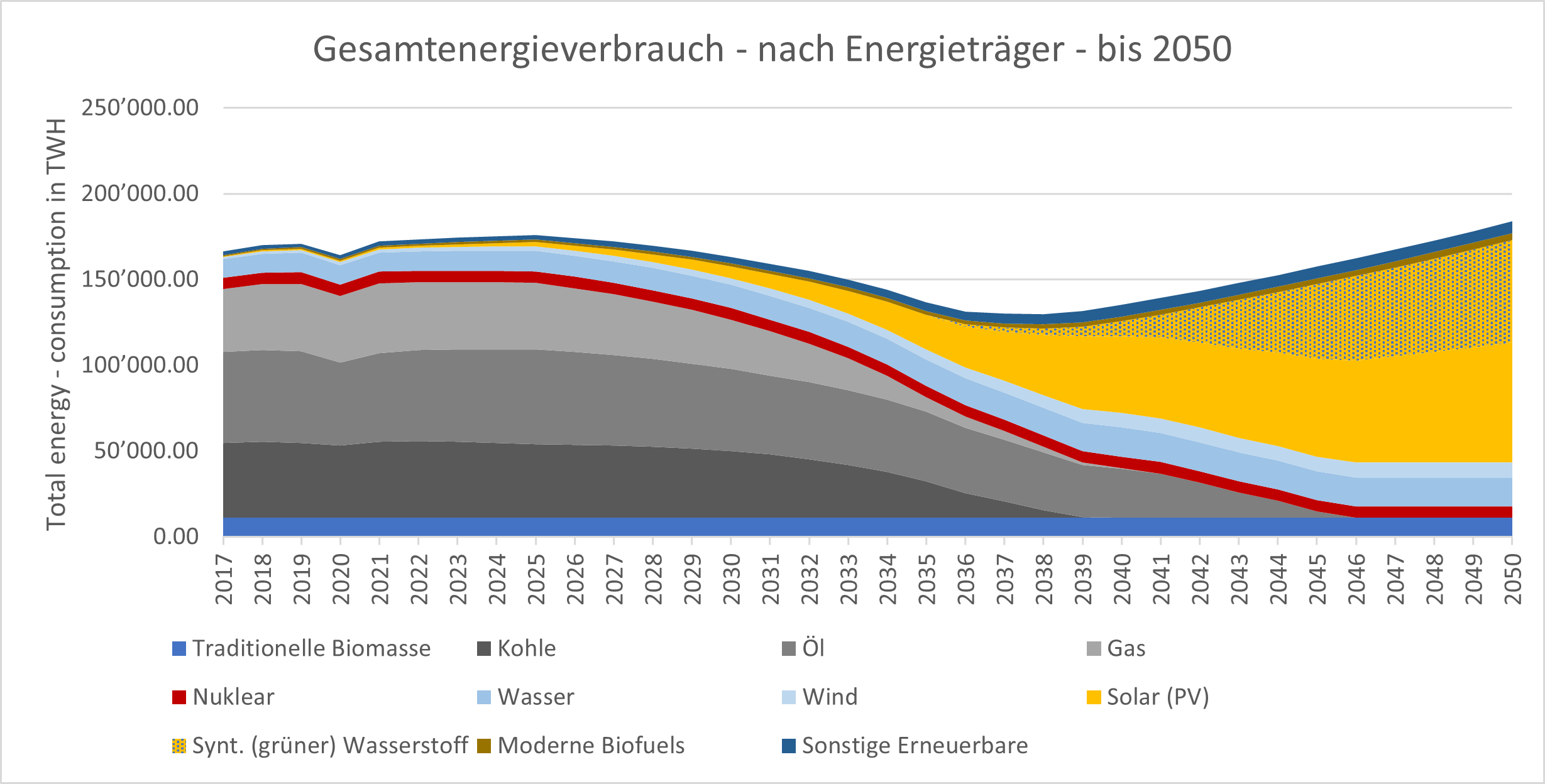
Scenarios: left – empirically based, right – effects of an immediate fall in the growth rate of renewables to 2/3 of empirical growth
With this very sharp and improbable fall in growth rates the transition will be delayed, but not substantially. Even sharper slumps in the transition would be needed for that.
A more detailed risk analysis requires corresponding economic knowledge. At what stage in the development of a technology does the market adjust to the disruption, when does the risk of a fire sale increase significantly?
Sectors that will be affected by the technology transition are, for example:
Automotive (e-mobility)
Housing sector
Fossil and nuclear power plants
Fertiliser and plastics industry
Long-distance transport (air and shipping traffic)
Energy-intensive industries (questions of location)
Financial sector – AM, WM, pension funds, IB (exposures in the affected sectors, spill-over effects)
Etc.
Technological change and the unbroken trend towards higher energy efficiency will considerably influence these and other sectors. As a result, the weights of entire economies and entire regions will shift.
One's own conviction
One of the greatest risks is one's own conviction, grown out of valid arguments and updated on the basis of current press reports. Unfortunately the press has in many cases lost touch, so that the updating of one's own information cannot keep pace with actual developments. The time to read popular science articles – who still has that. In times like those of recent years, Corona, Russia's war of aggression, Trump as president, the opportunity to do so is honestly lacking.
On top of all that, there are also almost irrefutable arguments such as the following: the fossil energy industry has such deep pockets that it can undermine the transition at any time. It can push oil prices down so far that the energy transition comes to a standstill. This argument does not stand up to analysis; the oil economies have become accustomed to their standard of living, and the money is spent as quickly as it is earned. These economies cannot put up resistance in the long run.
We cannot address all the arguments here, but none of the arguments known to us that cast doubt on the unchecked progress of the transition stands up to careful analysis.

Risk analysis
Risk analysis is just as complex as risk identification. Even if the rapid transition, and with it the disruption, is identified as probable, the scale for the sectors affected is not intuitively accessible; it requires far-reaching analyses.
In order to classify the risks adequately, the size of the global energy market, the economic constraints that go with it and the forces of inertia are particularly important criteria. The German automotive sector is currently experiencing what it means not to have recognised the change quickly enough.
In a rapid transition, the disruption and the fire sale in fossil assets are unavoidable. The point in time at which they set in, however, can hardly be forecast reliably. But there are tipping points.
Peak oil, expected in 2025/2026, is certainly a moment that will make the markets sit up and perhaps even tip them over. Should this be accompanied by strongly growing e-mobility, nervousness on the energy markets is to be expected, especially as the market in fossil fuels has already been left behind by the global equity market.

Sector-specific aspects must not be neglected either. Energy-intensive industries may serve as an example. Is it worth relocating production sites to sun-rich regions, or can corresponding counter-measures be taken by individual companies or groups of companies in central Europe as well? Which support measures should policymakers take to safeguard locations?
Further aspects apply to policymakers. What are the risks of political support that comes too early and is too high, and what are the risks of support that is too hesitant? How can the challenges be conveyed to industry and to the population if there is no communicated transition path? Where is the willingness to invest supposed to come from, even if the ROI is short. The risks grow with the population's uncertainty about the transition path.
The two steps of risk identification and risk analysis are the central challenges in risk management. Without them the further steps cannot be carried out. The question of whether and to what extent they are economically affordable is not yet answered by this.
Please do not approach risk management for the energy transition with the ECB's motivation on the “2022 climate risk stress test”: “a joint learning exercise with pioneering characteristics.” It is long since too late for a joint learning exercise with pioneering characteristics; that is far too dangerous.